Blog · AI

Foundational Model and F5 AI Guardrails for the Enterprise
See how foundational AI becomes enterprise-ready with F5 AI Guardrails, securing prompt injection, PII leaks, and other LLM risks.
6–8 minutes
Build for the Future: Make Foundational AI Work for You
Foundational AI pays off fastest when you point it at the tedious work your engineers dread. Instead of asking a senior analyst to scroll through endless security events by hand, a well-scoped model can map anomalous patterns in seconds and draft a remediation outline your team can act on. That is where foundational AI delivers its most immediate enterprise value.
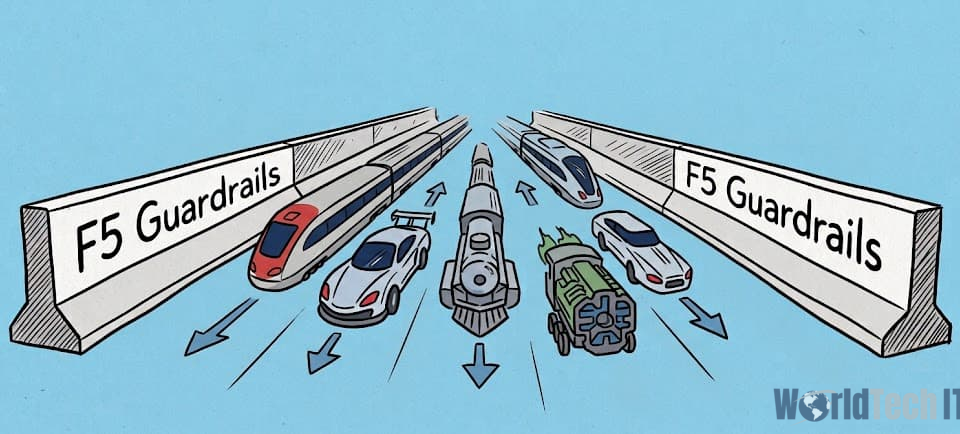
The trick is not hiding from the technology out of fear of hallucinations or compliance gaps. It is setting clean operational guardrails, which is exactly what an AI gateway like F5’s AI guardrails is built to enforce.
WorldTech IT helps you move past the early deployment friction to a stable compute environment and scalable F5 Distributed Cloud multi-cloud networking. Together with F5, we configure the network pipeline underneath so you can put foundation models to work safely and at scale for enterprise AI. The rest of this post walks through how that streamlining actually happens, and where it earns its keep.
What Are F5’s AI Guardrails?
In short, it is a control point that inspects and secures the traffic flowing to and from your large language models, handling authentication, rate limiting, and prompt-level security in one place. IBM’s explainer on what an AI gateway is frames it well: think of it as a reverse proxy purpose-built for AI. Modern AI gateways give enterprise AI teams a single choke point to enforce policy before models ever touch sensitive systems.
What Are the Root Advantages: Why does it matter for your Foundational AI?
AI’s upside is broad, but breadth alone doesn’t build a business case. Here is where enterprise teams see the clearest return.
Speed and scale: every LLM, regardless of type, shares one appeal. It automates routine work so your team can focus on the triage that genuinely needs a human. This is where enterprise AI solutions earn their keep, and it is why so many teams are now shopping for AI for enterprise workloads.
Traffic smoothing and pre-allocation: given the right context, a model can predict traffic spikes and pre-allocate capacity (more servers, bandwidth, or cache) before demand hits. Spikes are unpredictable, but with the right AI infrastructure in place, autoscaling serves as a buffer that prevents bottlenecks.
Model agility and abstraction: state intent in plain English (“allow payments from Service X to Database Y”) instead of memorizing low-level commands. Roll out changes in small steps, and when something breaks, spot it and roll back.
Threat spotting: a model can pull and correlate logs, flag unusual patterns, surface the next question a threat hunter would ask, and summarize findings into recommended next steps. Done right, this is a foundational AI model that secures you, not against you.
The Attack Surface Foundational AI Creates
Ever stop to think about what happens the second you plug a brand new model into your network? Whether it’s a chatbot that reads internal docs or an agent that takes action, it creates a new path into your network. That expands your attack surface, just like a new API or remote-access tool.
Here’s the thing though — most security teams haven’t had to watch for this particular flavor of trouble before. AI brings its own security vulnerabilities: prompt injection, data theft through carefully worded questions, and models that reveal more data than they should.
Attackers are already using AI-powered tools to find these weak spots at scale. That part keeps me up at night a little, honestly.
Now, I’m not saying any of this to scare you off foundational AI. Far from it. I’m saying it because you test everything else exposed to the internet, so why would AI get a pass?
Add your AI endpoints to your existing penetration testing program for web apps and APIs. Use the findings to improve your guardrails instead of guessing.
Fair warning: expect some false positives at first. That’s part of tuning the system to your environment. Annoying? Sure. But it’s cheaper than dealing with an incident.
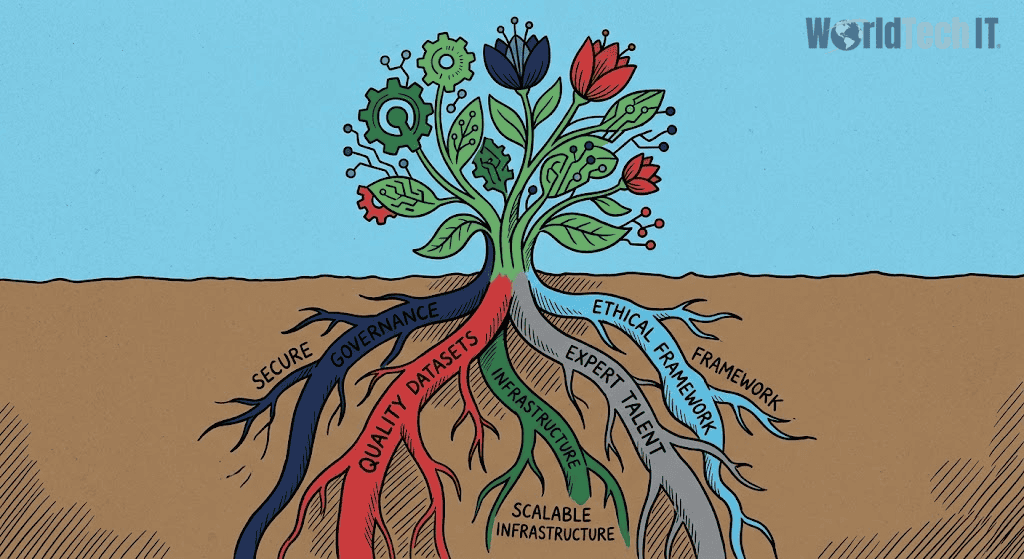
The takeaway: integrate security into the AI pipeline from the start, not after the model ships. F5 AI Guardrails do exactly that.
Security at the Edge: Added Runtime Layer for your Foundational AI
The case for edge inspection is straightforward. Traditional API and application security tools were built for deterministic traffic, and AI traffic is anything but. As F5 argues in its AI Gateway announcement, existing API and app security is not enough on its own. Inspection has to move up to the AI layer, pre-qualifying prompts and responses before they reach the model or your core systems.
Boosting your Foundational AI Model’s Security with Guardrails
A model without guardrails can hurt operations at any scale, from a minor slowdown to a serious breach. This is the heart of LLM security: understanding the LLM security risks in play and deploying controls that close them before they become incidents. The goal is simple. Let the model serve your enterprise needs without opening a door for insider threats or accidental leaks. So how do you get ahead of those risks?
Prompt injection defenses come first. Without an inspection layer, a threat actor can bury malicious instructions inside an otherwise innocent-looking prompt, tricking the model into ignoring its own rules. These prompt injection attacks top OWASP’s list of LLM risks, and defending against LLM prompt injection attacks is table stakes for any LLM application security program.
Data masking and PII redaction matter because sensitive data is easy to name and hard to catch in real time. By enforcing PII redaction and LLM data security at the gateway, you can let employees work with the model freely without it relaying names, account numbers, or other regulated data.
Rate limiting and token throttling cap how fast any user, or bot, can hit the system, which keeps resources from being exhausted and the service from slowing to a crawl. Rate limiting at the gateway is also why LLM gateways scale so gracefully.
Compliance content filtering keeps harmful text, secrets, and policy violations out of your logs, tools, and user-facing responses. Layering these four controls together is what LLM security best practices look like in production.
F5’s AI Gateway is built for exactly this. It inspects AI traffic and does not stop at the network level. It adds prompt-level controls, including prompt injection protection, PII detection and redaction, rate limiting, and content filtering, that older F5 Advanced WAF and API security tools were never designed to provide. Pair it with WorldTech IT’s Network Engine as a high-performance hypervisor, and those security services run faster and more predictably. Network Engine delivers bare-metal speed with low jitter and 40/100 Gbps line-rate throughput, so you can stand up virtualized security appliances without the usual latency tax.
High-Impact Enterprise Use Cases
Secure internal knowledge engines connect private repos and internal knowledge hubs (SharePoint, Confluence, file servers, PDFs) to a foundational model that lives inside your private cloud or enterprise network, not on the public internet. A Retrieval-Augmented Generation (RAG) pattern lets the model pull the relevant documents first and answer directly from them, which keeps responses grounded and cuts down on hallucinations.
High-velocity customer experience comes from a low-latency caching layer in front of the model so common requests return in sub-second time. Semantic caching means repeat questions never hit the model twice, which trims both cost and latency for customer-facing AI.
Automated middleware orchestration uses the model to translate and map real-time data streams between systems that were never designed to talk to each other, turning brittle point-to-point integrations into a single layer you can adjust in plain language.
Guardrails for AI Agents
AI agents raise the stakes: they don’t just give answers. They take action, like booking meetings, opening tickets, or moving files, often without human approval.
The more an agent can act on its own, the stronger your guardrails need to be. Think of an agent like a contractor with your credit card and keys. Set clear limits upfront. Start with permissions.
Limit what the agent can access, including your CRM, ticketing system, and payment processor. If it shouldn’t transfer $50K, change access, or email the CEO, it shouldn’t have access to those systems.
Then audit every action. Track every ticket, file, and email so you can see exactly what happened if something goes wrong. Finally, build in a pause. If an agent tries something unusual, like a large transfer or permission change, stop it and ask a human to approve it. Not every action needs approval, but the big ones do.
None of this is a reason to avoid agentic AI. It’s a reason to build the oversight in from the start, before the first agent goes into production.
Architecting the Future: The WTIT and F5 Advantage
The end state is a private, secure enterprise AI platform your teams can actually trust in production.
For F5 AI Gateway deployments, we deploy F5 AI Guardrails as an intelligent reverse proxy in front of your models, giving you centralized visibility, semantic caching, and content-based routing from a single control point instead of bolting policy onto each application.
On the WTIT engineering side, our professional services team designs, scales, and maintains the private, high-performance LLM infrastructure underneath, from compute and networking to the guardrails that keep it compliant as you grow.
Combined with F5’s AI-discovery platform, acquired through SurePath AI, F5’s AI Guardrails also give you a way to contain AI workloads internally without worrying about the risks of shadow AI running unmonitored.
Conclusion & Next Steps
The real work is in the pipeline, not the model. Getting value from foundational AI is less about tuning the model and more about optimizing the network pipeline and the guardrails around it. Nail that, and the model becomes something you can put into production without holding your breath.
If you’re weighing how to secure foundation models in production, or how to build compliance and governance into your AI applications from the start, we’d like to help. Talk to the WorldTech IT engineering team for an infrastructure and architectural review, and we’ll map out what a secure, scalable deployment looks like for your environment.
Further Reading: